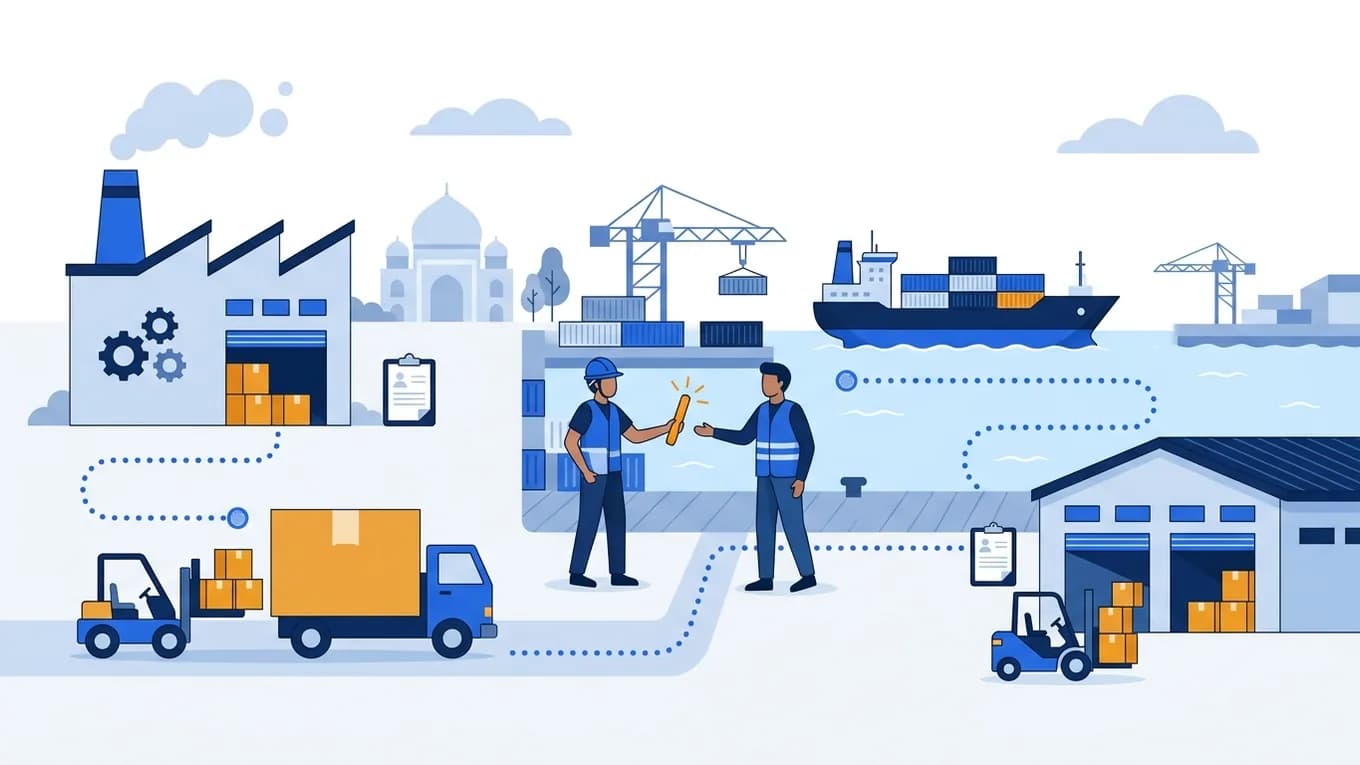
What an Incoterm does
An Incoterm is a three-letter term in your sales contract, such as FOB Mumbai or CIF Hamburg. The International Chamber of Commerce (ICC) publishes the rules. The current edition is Incoterms 2020, in force since 1 January 2020.
Each rule answers three questions: where the seller delivers the goods, who pays for which part of the journey, and where the risk of loss or damage passes from seller to buyer. Always write the place after the term. FOB on its own does not say which port.
The 11 rules in two groups
Seven rules work for any kind of transport, including containers, air and road:
- EXW (Ex Works): the seller makes the goods available at its own premises. The buyer does everything else, including export clearance.
- FCA (Free Carrier): the seller hands the goods, cleared for export, to the carrier the buyer has chosen, at the seller's premises or another named place.
- CPT (Carriage Paid To) and CIP (Carriage and Insurance Paid To): the seller pays the carriage to the named destination, and under CIP the insurance too. The risk passes in the seller's country, when the goods are handed to the carrier.
- DAP (Delivered at Place): the seller bears the cost and risk to the named place, with the goods ready for unloading. The buyer unloads, clears import and pays the duty.
- DPU (Delivered at Place Unloaded): like DAP, but the seller also unloads. It replaced the old DAT.
- DDP (Delivered Duty Paid): the seller delivers to the named place cleared for import, with the import duty and taxes paid.
Four rules are for sea and inland waterway only:
- FAS (Free Alongside Ship): delivered alongside the ship at the port of shipment.
- FOB (Free On Board): delivered on board the ship at the port of shipment. The risk passes there.
- CFR (Cost and Freight): the seller pays the sea freight to the destination port, but the risk passes once the goods are on board in the seller's country.
- CIF (Cost, Insurance and Freight): CFR, plus insurance that the seller buys for the buyer.
Six rules you will meet often
Six rules come up again and again on Indian quotes. Each has a catch:
- EXW: the ICC says it suits mainly domestic trade. It leaves export clearance to a buyer abroad, so agree in writing who files the shipping bill, or quote FCA instead.
- FOB and CFR: made for goods loaded straight onto a ship, such as bulk cargo. For containers, the ICC points to FCA or CPT.
- CIF: the seller needs to insure only to the minimum level, Institute Cargo Clauses (C). CIP requires the wider Clauses (A). If you want more cover under CIF, write it into the contract.
- DAP: the seller takes the goods to the buyer's named place, but the buyer still clears import and pays the duty.
- DDP: the seller also clears the goods for import and pays the duty and taxes in the buyer's country. The ICC warns that a seller may not be able to do this, so use it with care.
Watch out: A common mistake is using FOB or CIF for container cargo. A container is handed to the shipping line at a depot or terminal before it is loaded, yet under FOB and CIF the risk stays with the seller until the goods are on board. FCA, CPT and CIP match how containers move.
How the Incoterm changes the customs value
For an import, Indian customs charges duty on the assessable value. Under section 14 of the Customs Act, 1962, that is the price for delivery at the place of importation, including the cost of transport and insurance to that place. So your Incoterm decides what customs adds to the invoice price:
- Bought EXW, FCA or FOB: customs adds the freight and insurance to the Indian port.
- Bought CFR: customs adds the insurance.
- Bought CIF: the price already includes both.
- Bought DAP or DDP to your door: the price includes costs after the goods reach India, so ask your customs broker how to show them on the bill of entry.
- A supplier in China quotes USD 10,000 FOB Shanghai. Sea freight to Nhava Sheva is USD 800 and insurance USD 50.
- CIF value: 10,000 + 800 + 50 = USD 10,850.
- At an illustrative customs rate of ₹85 per dollar, the assessable value is 10,850 × 85 = ₹9,22,250, not the ₹8,50,000 the FOB price alone comes to.
- The freight, insurance and rate here are only for illustration. Customs uses the customs exchange rate in force on the day the bill of entry is filed.
For an export, customs values the goods for delivery at the place of export. So on a CIF sale, the freight and insurance are taken out to reach the FOB value on the shipping bill.
Choosing a term
- Decide how far you can manage the journey: only to your gate, to the port or depot in your country, or all the way to the buyer.
- Match the term to the transport: FCA, CPT or CIP for containers and air; FOB, CFR or CIF for goods loaded straight onto a ship.
- Write the exact place after the term and name the edition, for example CIF Jebel Ali, Incoterms 2020.
- Check that the insurance, the freight booking and the documents your bank needs all fit the term.
In short
- Incoterms 2020 is the current ICC edition: 11 rules, seven for any transport and four for sea only.
- Each rule sets where the seller delivers, who pays which costs, and where the risk passes.
- For containers, FCA, CPT and CIP fit better than FOB, CFR and CIF.
- Indian import duty is worked out on the value delivered to India, so customs adds the freight and insurance your price leaves out.
Try it on our data
Check yourself
Words in this lesson
Sources
- ICC: Incoterms rules
- ICC: Incoterms 2020
- ICC: Incoterms 2020 checklist and flowcharts
- CBIC: Customs Act, 1962 (section 14, valuation of goods)
Facts checked against these sources on
Trade Academy is education, not legal, tax or customs advice. Rules and rates change by notification: check the live source, or ask a licensed customs broker, before you act.