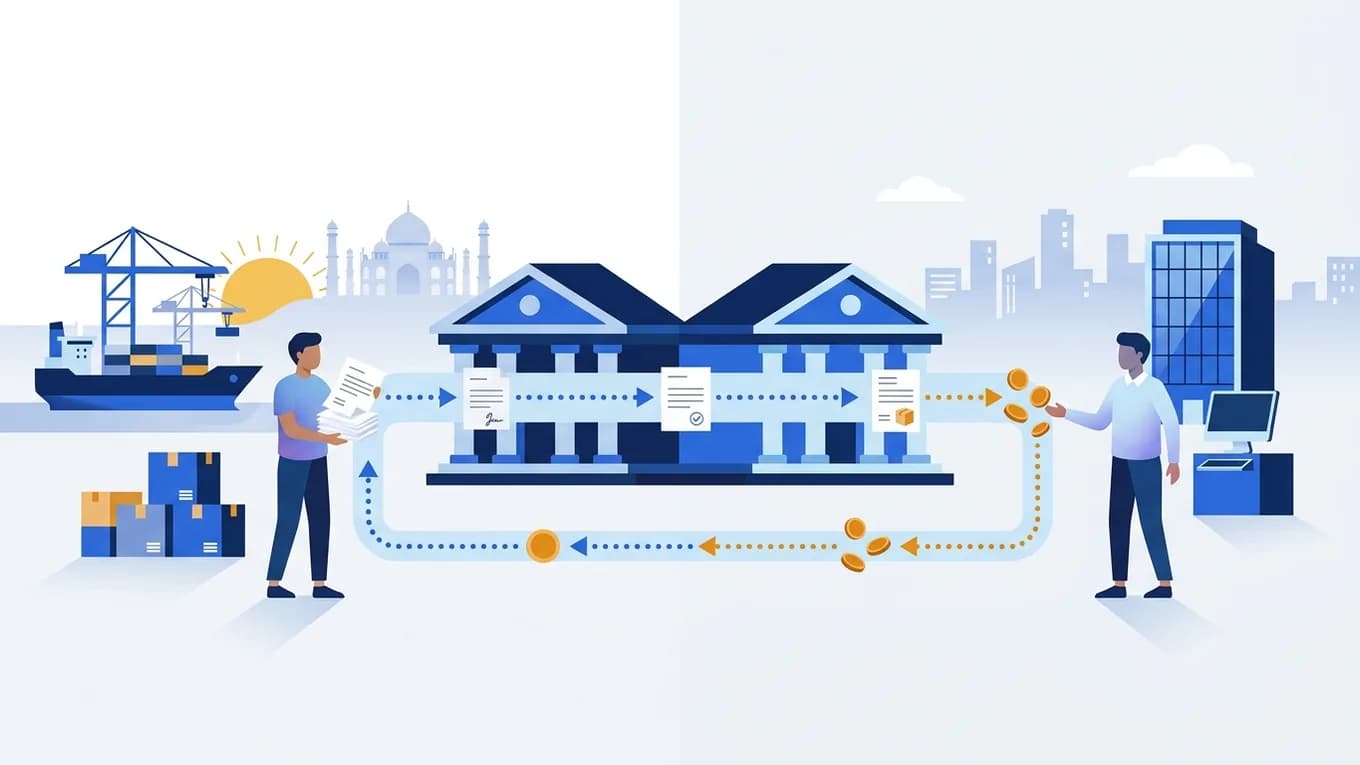
Four ways to be paid
How you are paid decides who carries the risk. At one end the buyer pays before you ship; at the other you ship and wait. In between, banks hold the documents that control the goods until the buyer pays or promises to pay.
- Advance payment: the buyer pays, in full or in part, before you ship.
- Letter of credit (LC): the buyer's bank promises to pay you when you present documents that match the credit's terms.
- Documents against payment (DP): you ship, and your bank sends the documents to the buyer's bank, which hands them over only when the buyer pays.
- Documents against acceptance (DA): the buyer's bank hands over the documents when the buyer accepts a bill of exchange, a promise to pay on a set later date.
Open account, where you ship and send the documents straight to the buyer, carries the most risk of all. Keep it for buyers who have paid you on time before.
Who carries the risk
- Advance: almost none for you. The importer carries it all and must trust you to ship.
- LC: low for you if your documents comply and the issuing bank is sound. The importer pays against documents, before seeing the goods.
- DP: the buyer can refuse to pay and leave your goods at a foreign port, but cannot take them without paying.
- DA: the highest of the four for you. The buyer has the goods and may not pay on the due date.
Watch out: The mistake exporters make with DP and DA is letting the goods go before the bank has collected: sending an original bill of lading straight to the buyer, or agreeing to a telex release. The bank can protect you only while it holds the documents that control the goods.
Documents through banks
Most letters of credit today are issued subject to UCP 600, the ICC's rules for documentary credits, in force since 1 July 2007. Collections such as DP and DA have their own ICC rules, URC 522. In a collection the banks pass on documents and money; they do not promise that the buyer will pay.
- You ship and collect the transport document, the invoice, the packing list and any certificate the buyer needs.
- You hand them to your bank with its request letter: the LC or collection terms, whether documents are released against payment or acceptance, and the buyer's bank.
- Your bank sends them to the buyer's bank, which releases them on the agreed terms.
- The money comes back through your bank, which records it against your shipping bill in EDPMS.
RBI's rules that shape your terms
- Take an export advance and the balance through the same bank. To switch banks, tell both.
- Be paid within 9 months of shipment, or 12 months if the export is invoiced or settled in rupees. Your bank can extend this if you explain the delay.
- If an export stays unpaid more than a year past its due date, you may export further only against full advance payment or an irrevocable letter of credit.
- On the import side, your bank decides whether to allow an advance, and can ask for a standby letter of credit or a guarantee above an amount it sets.
- Order value: USD 20,000. Terms: 30% advance, 70% DP.
- Advance before you ship: 20,000 × 30% = USD 6,000.
- Balance against documents: 20,000 − 6,000 = USD 14,000.
- If the buyer refuses the documents, you still control the goods and hold USD 6,000 towards bringing them back or selling them elsewhere.
Check the buyer before you agree terms
- Screen the buyer, its bank and anyone else in the deal against sanctions lists.
- Confirm the company exists: its registration in its own country, its address and website, and its LEI if it has one.
- Look for its import history. Customs records, where a country publishes them, show whether it really buys your kind of goods.
- Start with an advance or an LC, and move to DP or DA only after a few orders paid on time.
- Ask about export credit insurance. ECGC, a Government of India company, insures exporters against buyers who do not pay.
In short
- Advance is safest for the exporter and DA the riskiest; LC and DP sit between.
- Under an LC the bank pays only against documents that match the credit's terms.
- In a DP or DA collection the banks pass on documents and money; they do not guarantee payment.
- RBI wants export proceeds within 9 months of shipment, or 12 if invoiced or settled in rupees. A year past that, further exports need a full advance or an irrevocable LC.
Try it on our data
Check yourself
Words in this lesson
Sources
- ICC Digital Library: ICC rules, including UCP 600 and URC 522
- ICC Academy: Documentary credits, rules and terminology
- RBI: FEMA 23(R)/2026-RB, export and import regulations
- ECGC Ltd (Government of India enterprise)
Facts checked against these sources on
Trade Academy is education, not legal, tax or customs advice. Rules and rates change by notification: check the live source, or ask a licensed customs broker, before you act.