What a shipment record is
Every import into India is declared to customs on a bill of entry, and every export on a shipping bill. A shipment record is one line of such a declaration: who moved which goods, how much, at what value and when. SCM Insights shows these Indian customs shipment records one line at a time, so you can see real trade instead of guessing.
One record is a fact about one shipment. It is not a price list, a contact sheet or a promise of future orders. Read it the way a customs officer would: field by field, checking that the fields agree with each other.
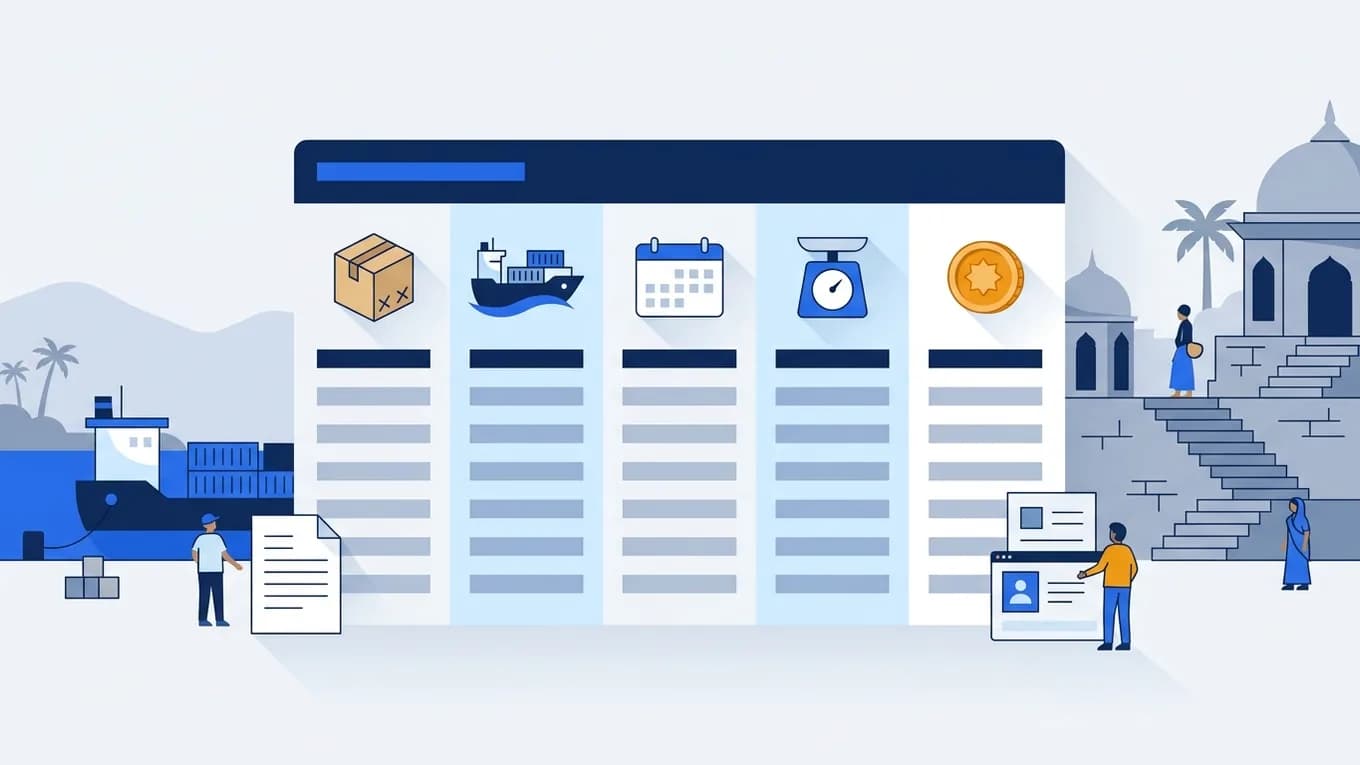
The fields, one by one
- Date: the date of the customs record. It is close to when the goods moved, not when the order was placed or paid.
- HS code: the 8-digit code the trader declared. It tells you the product family, but a declaration can be wrong, and similar goods can sit under neighbouring codes.
- Product description: the trader's own words for the goods, often with the grade, size, brand or model.
- Importer and exporter: the Indian company on the declaration, and the company abroad that sold the goods to it or bought them from it.
- Country: the other country in the trade. Records can also name the country of origin, where the goods were made, which may differ from the country they were shipped from.
- Ports and mode: where the goods were loaded and unloaded, and whether they went by sea, air or land.
- Quantity and unit: how many, in the unit given, such as kilograms, pieces, metres or pairs. Weight is a separate field, in kilograms.
- Value: what the goods were declared at. SCM Insights shows it in US dollars, and some views also show a unit price, the value divided by the quantity.
Trap 1: descriptions are free text
The description is typed by the trader or their customs broker, so there is no fixed wording. The same product can appear as 'T-SHIRT', 'TSHIRT', 'T SHIRTS 100% COTTON' or a model number with no product word at all. Spelling mistakes and short forms are common, and company names vary in the same way: 'Pvt Ltd', 'Private Limited' and a short form can all be one company.
- Search by the HS code first, at 6 digits and at 8 digits.
- Then search by two or three different words for the product, including the words buyers in your trade really use.
- Read a sample of descriptions under the code to see what is really being shipped, and set aside the lines that are a different product.
- Group the different spellings of one company before you count its shipments.
Trap 2: units and weights vary
Two records for the same code can use different units. One shows 1,000 pieces, another 250 kilograms, another 40 sets. You cannot add them up or compare their prices until they are in the same unit.
- Compare quantity with quantity only when the unit is the same.
- Use the weight field to bridge different units, remembering that a weight may or may not include packing.
- Expect units to change when codes change. India's official trade statistics site notes that some codes were dropped or re-allocated from April 2026, and that their units may have changed.
Trap 3: which currency, and which value
SCM Insights shows values in US dollars. The bill of entry and the shipping bill themselves carry the invoice in its own currency and a value in rupees, converted at the customs exchange rate in force on the day they are filed. Before you compare two figures, make sure both are in the same currency.
Check the basis too. Indian import values include freight and insurance to India, the CIF basis. Export values are taken at the Indian port of loading, the FOB basis. The next lesson shows how to compare the two.
Watch out: The most common mistake is to treat one record as the market price. A single shipment can be a sample, a free replacement, a mixed lot or a typing slip. Look at many records over several months before you draw a conclusion.
In short
- A shipment record is one line of an Indian customs declaration: date, HS code, description, companies, country, ports, quantity and value.
- Descriptions and company names are free text, so search by code and by several words.
- Compare quantities only in the same unit, and use weight to bridge units with care.
- Check the currency, and whether a value is CIF or FOB, before you compare.
- One record is not a market price: look at many.
Try it on our data
Check yourself
Words in this lesson
Sources
- CBIC: Customs Act, 1962 (Sections 14, 15 and 25)
- DGCI&S: Foreign trade statistics
- DGCI&S TradeStat: India's trade by HS code and country
Facts checked against these sources on
Trade Academy is education, not legal, tax or customs advice. Rules and rates change by notification: check the live source, or ask a licensed customs broker, before you act.