Start from the product, not the company
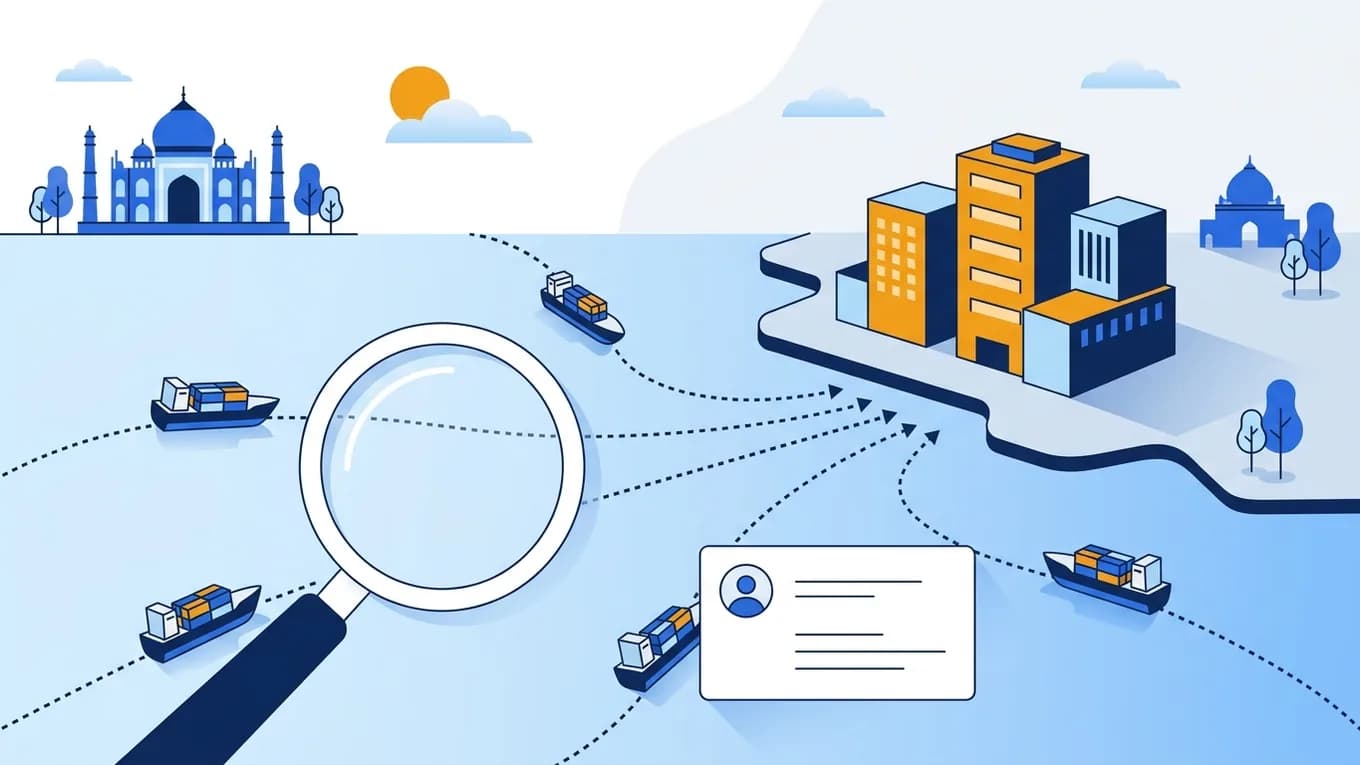
Every shipment record names the companies on both sides, so the records for your product are a list of who really buys and sells it. Start with your HS code at 6 or 8 digits, then add the words people use for the product, because some lines are described in other words or filed under a neighbouring code.
- To find buyers abroad for your exports, look at India's export records for your code: the company abroad is the buyer.
- To find buyers in India for goods you sell here, or to see your competitors' customers, look at import records: the Indian importer is the buyer.
- To find suppliers, turn it round: the company abroad on India's import records, or the Indian exporter on export records.
Active, regular or one-off
A name on one old record is not a buyer you can count on. For each company, look at three things: how recent its last shipment is, how many shipments it made in the last 12 months, and how evenly they are spread.
- Buyer A: 12 shipments in the last 12 months, about one a month, the last one three weeks ago, US$240,000 in all.
- That is 240,000 ÷ 12 = US$20,000 a shipment, bought steadily.
- Buyer B: one shipment eleven months ago, worth US$90,000.
- Buyer B spent more in one go, but Buyer A is the regular buyer. Buyer B may have bought once for a single project.
Watch out: Not every name on a record is the end buyer. It can be a trading house, an agent, a logistics company or a customs broker. Read the descriptions and the company's own website before you treat it as the buyer.
Check them before you contact them
- For an Indian company, check its IEC: DGFT lets anyone verify the details of an IEC on its website.
- Check its GSTIN on the GST portal's Search Taxpayer page. It works without a login and shows the legal name, the date of registration and the returns filed.
- For a company abroad, find its own website and its entry in its country's company register.
- Check the name against sanctions lists before you quote or ship. Our Company check tool searches UN, US and UK lists.
- Write down anything that does not match, such as a different name on the website, a cancelled registration, or a possible sanctions match, and resolve it first.
Reach out the right way
Write to one company at a time, about one product. Say who you are, what you make and why you are writing to them. Refer to what you know from the records only in general terms, such as the product they import. Offer one clear next step, such as samples or a price for a set quantity.
- Do not send bulk messages. Our directory's terms forbid using contact details for unsolicited bulk email, SMS or calls in breach of the law, including TRAI's rules on unsolicited commercial communication.
- Do not resell or share the contact data. The terms forbid that too.
- Follow up once or twice, spaced out, not every day.
- If someone says no or asks you to stop, stop.
Using our tools
Our directory lists Indian importers, exporters and customs brokers by company name, with their HS codes, number of shipments and the month of their last import. A filter shows only companies with an Indian import on record in the last 24 months. Contact details may be masked, depending on your access.
Buyers abroad lists the companies in Peru that imported your product from India, from Peru's own customs records, which its customs agency SUNAT publishes every week. For each buyer it shows the FOB value, the number of customs lines, the last import date, its tax ID and what it bought, with a link to check the company. Peru is the only country so far.
In short
- Shipment records for your HS code show who really buys and sells your product.
- Judge a company by how recent, how frequent and how regular its shipments are.
- Check the IEC, the GSTIN or the foreign company's registration, and screen the name against sanctions lists.
- Contact one company at a time with a relevant offer. Bulk unsolicited messages break our terms and the law.
Try it on our data
Check yourself
Words in this lesson
Sources
- DGFT: Handbook of Procedures, Chapter 2 (IEC details can be verified on the DGFT website)
- GST portal: Search Taxpayer without login
Facts checked against these sources on
Trade Academy is education, not legal, tax or customs advice. Rules and rates change by notification: check the live source, or ask a licensed customs broker, before you act.