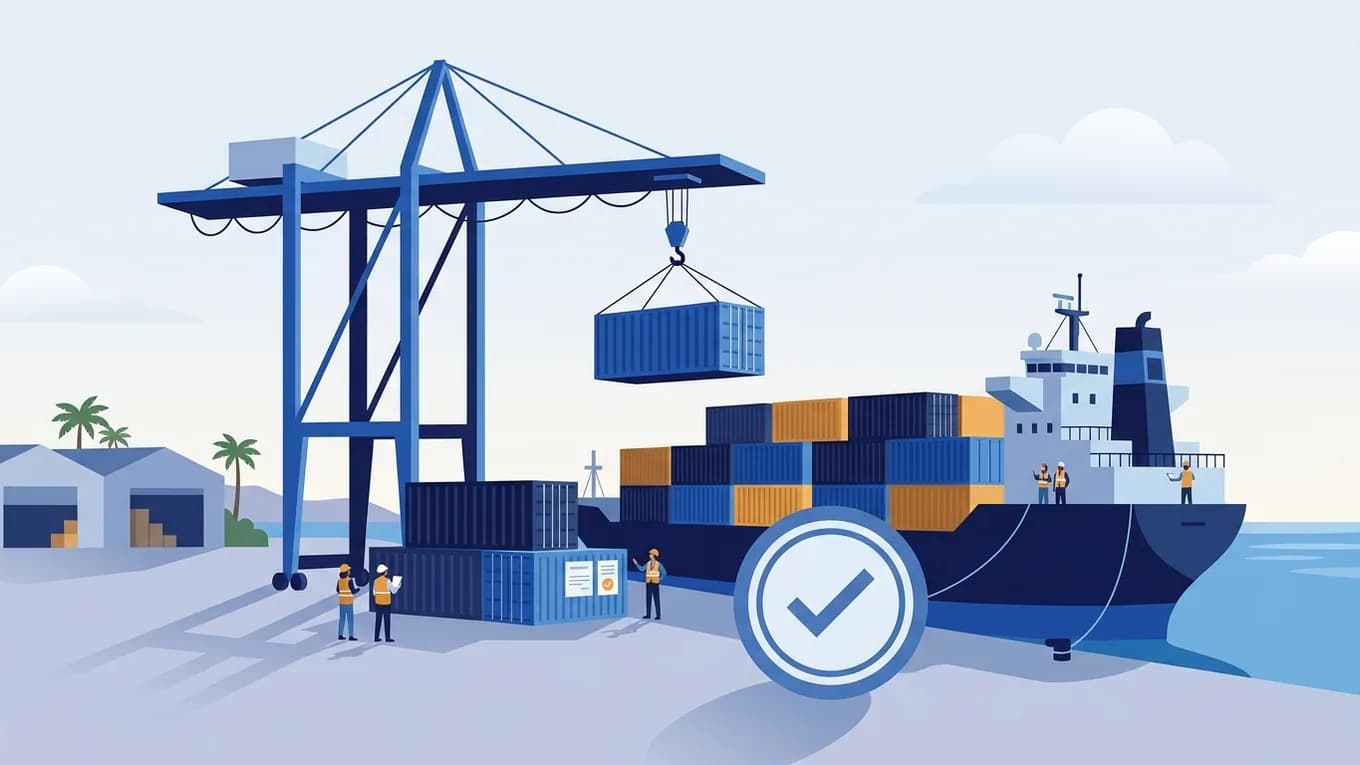
What a shipping bill is
A shipping bill is your declaration to Indian customs that you are exporting goods. At customs stations on the electronic system, it is filed on ICEGATE: by you with a digital signature, by your customs broker, or through a customs service centre.
The shipping bill counts as filed, and your own assessment of it as done, the moment the system gives it a number. From then on, customs checks what you declared.
What goes in it
The shipping bill carries most of what is on your export papers. Customs, your bank and, later, the buyer's customs compare these details against each other.
- Who: your IEC and GSTIN, the buyer, the consignee if different, and your customs broker's licence number.
- Where: the port of loading, the port and country of discharge, and your bank's AD code, which links the export to your bank.
- The invoice: the commercial invoice number and date, its currency, the Incoterm, and the value split into FOB, freight, insurance, commission and discount.
- The goods: for each item, the description, quantity, unit value, HS code, packages and weights.
- GST: whether you export on payment of IGST, or under a bond or LUT without paying it.
- Schemes: whether you claim duty drawback, RoDTEP or another export benefit on each item.
From filing to Let Export Order
- You or your broker file the shipping bill on ICEGATE and upload the supporting documents, such as the invoice and packing list.
- The goods arrive at the port, airport or inland container depot named in the shipping bill.
- Customs checks the declaration. It may examine the goods or clear them on the documents alone. If any export duty or cess is due, you pay it.
- Customs then makes the order that permits clearance and loading under section 51 of the Customs Act: the Let Export Order (LEO). It is recorded on ICEGATE and sent electronically to you or your broker and to the terminal holding the goods.
- Only now can the goods be loaded. The shipping line or airline then files its export manifest (EGM) with customs.
Keep the assessed shipping bill and the documents behind it for five years from the date you filed it. The regulations on electronic shipping bills require it.
The same filing is your declaration to RBI
From 1 October 2026, RBI's Foreign Exchange Management (Export and Import of Goods and Services) Regulations, 2026 apply. Every export of goods must be declared on an Export Declaration Form (EDF) at the time of export. For goods shipped through an electronic (EDI) port, the EDF is treated as part of the shipping bill, so there is no separate form to file. The export then appears in EDPMS, the system banks use to track export payments.
- Get paid within 9 months from the date of shipment, or 12 months if the export is invoiced or settled in rupees. Your bank can give you more time if it accepts your reasons.
- When the money comes in, your bank closes the EDPMS entry. Up to ₹10 lakh per shipping bill, it can close the entry on your declaration that you were paid.
- If an export is still unpaid a year after its due date (or the extended date), you may export only against full advance payment or an irrevocable letter of credit.
- You ship goods on 10 November 2026 and invoice the buyer in US dollars.
- Nine months from the date of shipment: be paid by 10 August 2027.
- Had you invoiced in rupees, the limit would be 12 months: 10 November 2027.
Export incentives claimed in the shipping bill
Two schemes give back duties and taxes that went into your export. Both are claimed by a declaration in the shipping bill itself.
- Duty drawback refunds customs and central excise duties paid on the materials used to make the goods, mostly at All Industry Rates the government fixes for each product. Customs treats the electronic shipping bill as your drawback claim, filed on the date of the Let Export Order, and pays the amount to you.
- RoDTEP refunds duties, taxes and levies on inputs that no other scheme refunds, at the rates in DGFT's Appendix 4R and 4RE. Once the export manifest is filed, customs processes the claim and the credit appears in your ICEGATE account. You turn it into an e-scrip, which you can use to pay basic customs duty on imports or transfer to another IEC holder.
- RoDTEP runs for fixed periods. DGFT's notification of 30 September 2026 continues it until 31 December 2026; check DGFT for any later date.
Watch out: Decide which benefits you claim before the shipping bill is filed, tell your broker, and check the draft for each claim. Getting it right at filing is far easier than asking customs to convert the shipping bill to another scheme later.
In short
- The shipping bill is your export declaration, filed on ICEGATE by you or your customs broker.
- It counts as filed and self-assessed once the system gives it a number.
- Goods are loaded only after customs gives the Let Export Order.
- From 1 Oct 2026 the shipping bill is also your EDF for RBI: get paid within 9 months, or 12 if invoiced in rupees.
- Duty drawback and RoDTEP are claimed in the shipping bill itself.
Try it on our data
Check yourself
Words in this lesson
Sources
- CBIC: Shipping Bill (Electronic Integrated Declaration and Paperless Processing) Regulations, 2019
- CBIC: Customs and Central Excise Duties Drawback Rules, 2017
- RBI: FEMA (Export and Import of Goods and Services) Regulations, 2026
- ICEGATE: Advisory on e-scrips for RoDTEP and RoSCTL
- DGFT: Notifications (41/2026-27, RoDTEP continued to 31 Dec 2026)
Facts checked against these sources on
Trade Academy is education, not legal, tax or customs advice. Rules and rates change by notification: check the live source, or ask a licensed customs broker, before you act.